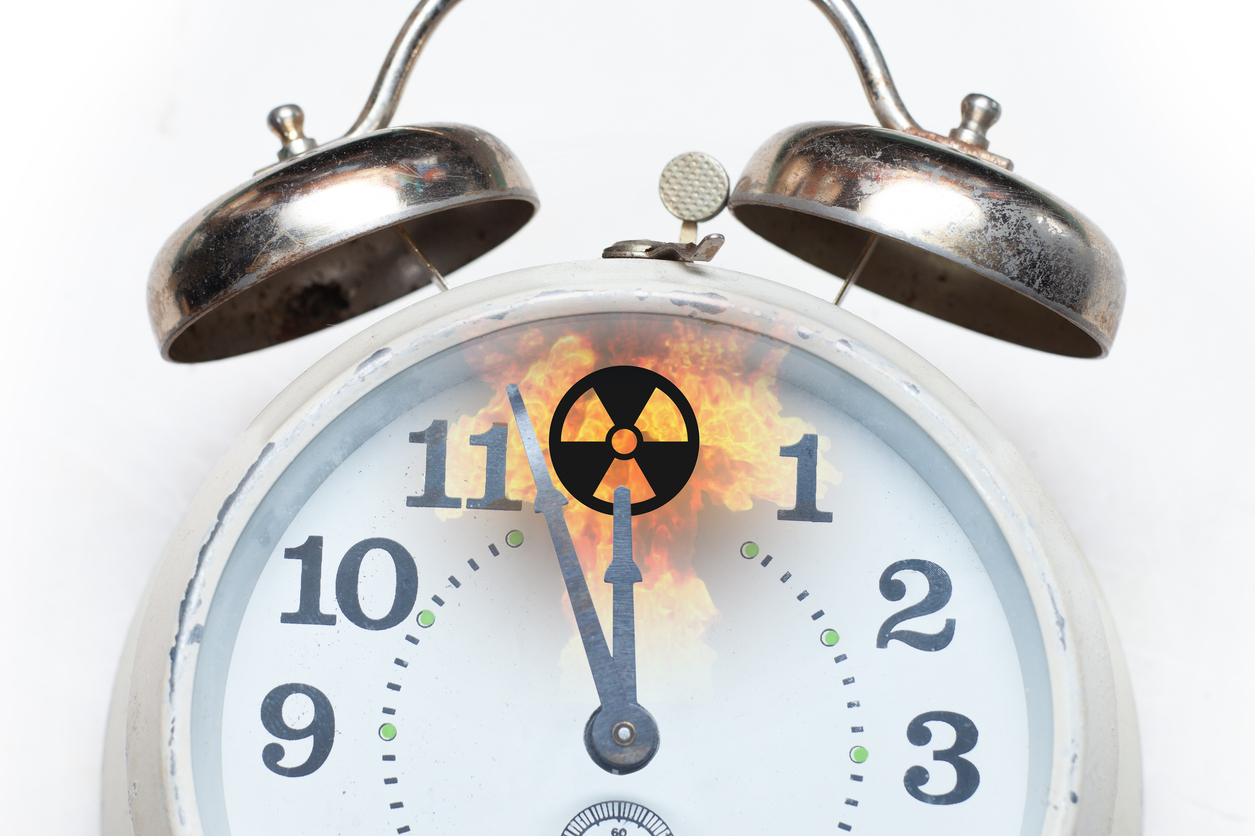
THREE THREATS. DO NOT LOOK AWAY
In recent years, I have firmly believed the greatest threats to humanity are, primarily climate change, and increasingly, Artificial Intelligence (AI). They remain existential dangers. But in the past month, a third threat has forced its way out of the shadows and back into full daylight: nuclear weapons. As of January 2025, the world has an estimated 12, 241 nuclear war heads and arms control continues to weaken with many treaties expired or abandoned.
The Cold War relic we thought had been consigned to history’s back shelf is again centre stage. And the fate of the global community rests at the centre of it all. Russia and the United States are once more rattling their nuclear sabres, moving them from the back door to the front doorstep of global politics.
In late July 2025, former Russian president, now deputy head of the Security Council, Dmitry Medvedev issued nuclear-coded warnings, invoking the Soviet-era “Dead Hand” doomsday system, accusing the U.S. of overt ultimatums, and hinting that Russia might respond in kind.
Within days, U.S. President Donald Trump took to Truth Social to declare:
“Based on the highly provocative statements of the Former President of Russia, Dmitry Medvedev, who is now the Deputy Chairman of the Security Council of the Russian Federation, I have ordered two Nuclear Submarines to be positioned in the appropriate regions, just in case these foolish and inflammatory statements are more than just that. Words are very important, and can often lead to unintended consequences, I hope this will not be one of those instances.”
This was, and remains, a terrifying escalation not just because of the weapons themselves, but because of the volatility of the people holding the launch codes. Leaders who measure success in dominance, see compromise as weakness, and live for the instant gratification of winning the day are not wired for the patience and restraint nuclear stewardship demands. In such hands, a miscalculation, a personal affront, or even a poorly chosen phrase could ignite a chain of irreversible events for every person on this planet.
In a sane world, the return of nuclear brinkmanship would dominate headlines until addressed. Instead, it flared briefly in the news cycle before being swept aside by the churn of the next scandal, the next outrage, the next distraction. Cold War-level terror was replaced by tabloid fodder. The headlines moved on.
The danger, however, was never gone. Only our attention was. And that may be the most dangerous truth of all.
The three threats, climate change, AI, and nuclear weapons are the kind of challenges that demand long-term thinking. They don’t respond to slogans or short-term fixes. They require steady hands, even steadier minds, cross-border cooperation, and humanity-focused vision that stretches far beyond the next quarter’s profits or the next election. They require sustained commitment and determination, even when the work is slow, hard, absent of glory, and risking votes.
Yet our systems reward the opposite: short-term wins over lasting solutions, leaders who promise results in months instead of decades, funding that follows noise rather than necessity. And painfully, a time when the previously unacceptable has become acceptable. We tolerate corrosive rhetoric and power plays, even when they chip away at trust, dignity, and truth itself.
The result is a dangerous complacency, treating existential risks like passing weather. We look up only when the storm is directly overhead, by which point it’s too late to build shelter. And when disaster strikes elsewhere, we watch from a distance, comforted by the false belief that it cannot happen to us. Until it does.
These are not problems we can outspend, outfight, or outcompete. AI must be guided, not defeated. The climate will not wait for us to ‘get around to it’; every year of delay locks in more damage. Nuclear weapons will not disappear through wishful thinking – they demand a collective, deliberate step back from the edge.
And this is where individual responsibility becomes non-negotiable. Yes, governments, institutions, and corporations carry enormous influence, but they move when people make it impossible to stand still. That pressure starts with us. It lives in how we vote, what we choose to support, what we refuse to tolerate, and what we teach the next generation about dignity, empathy, and truth. It’s in the conversations we have and just as importantly, the silences we refuse to keep, when something is wrong. The collective strength to protect one another is built from individual choices. Without each of us accepting our share of that work, there is no ‘we’ strong enough to hold the line.
Already, the warning signs are undeniable. Generative AI advancing without ethical guardrails. I’ve written before about the urgent need to guide AI with human values, rather than letting machines define the way forward. If we don’t steer, they will and not always in our favour. The climate system tips toward irreversible damage. Alpine towns again evacuating as thawing permafrost triggers rockfalls; glaciers vanishing, lakes forming in their place; nuclear arsenals once again discussed as tools of strategy instead of instruments of horror.
We are living in the moment where 2001: A Space Odyssey’s abyss stares back at us, Mad Max’s wastelands feel within reach, and The Book of Eli’s post-apocalyptic desolation seems plausible. Even The Day After Tomorrow’s sudden climate collapse no longer feels far-fetched. Whoever imagined these futures might converge into one could never have foreseen we would be living their opening act.
We have allowed those fictional nightmares to bleed into our reality and then look away. Here’s the truth: Climate, AI, Nuclear are not metaphors. They are real. They are dangerous. And they are here. Right here. Right now.
Which is why we must demand of ourselves, and our leaders, that we do the right thing. We have the tools. We have the knowledge. What we need now is the will, not only from our leaders, but from each of us. To think beyond the next headline. To act with the future in mind. To speak up when silence would be easier.
Because if we do not, if we consciously fail, the bleak landscapes of The Book of Eli will not be cautionary fiction. They will be the history we leave behind.

Living in the moment, not for it: stopping the surge of social media for the sake of it